
SYRIA: Two Asian Carriers to Begin Transiting Syrian Airspace from End-October
DAMASCUS, Syria: Syrian General Authority of Civil Aviation and Air Transport says two unspecified Asian carriers will begin transiting Syrian airspace en-route from Asia to Europe and other destinations at the end of October 2026.
DAMASCUS, Syria
- The Syrian General Authority of Civil Aviation (SGACA) says two unspecified Asian carriers will begin transiting Syrian airspace en-route from Asia to Europe and other destinations at the end of October 2026.
- According to Syria TV, the authority has received multiple overflight requests from Asian countries to use the Damascus Flight Information Region (FIR). Two carriers were initially approved.
- The approvals coincide with updated positive safety assessments of Syrian airspace by the European Union Aviation Safety Agency (EASA) and a reported reduction in risk for higher-level overflights.
- Only specific portions of Syrian airspace that meet technical and safety standards will be available.
- The statements followed a meeting between the Syrian authority and a European Union delegation in Syria on expanding air transport cooperation with European states.
- The authority said it will work to remove remaining obstacles so that all of Syrian airspace can be approved for transit in line with international safety standards.
- Recent developments in the sector include upgrades at Damascus International Airport and Aleppo Airport and the introduction of a new air route, Route L602, near Deir ez-Zor.
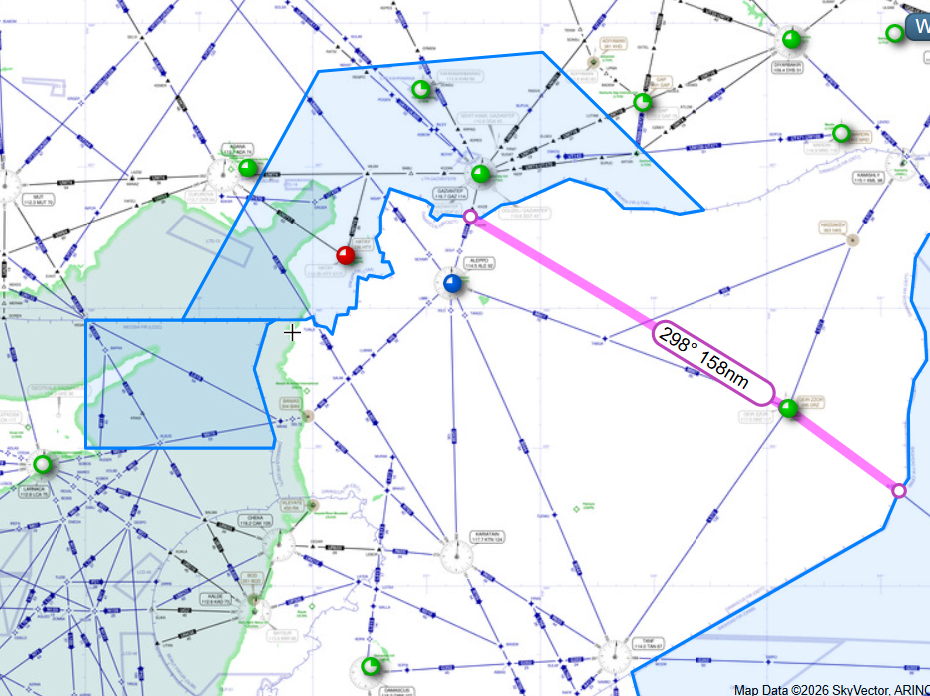
- SGACA adopted airway L602 in September 2026 as part of a wider airspace redesign. The RNAV5, Class A route runs eastbound only through eastern Syrian airspace near Deir ez-Zor, from the FIR boundary at waypoint ELEXI via the Deir ez-Zor VOR/DME (DRZ) to TUSYR. It is available for overflight between FL280 and FL430 at the published levels (FL280, FL300, FL340, FL380, FL400 and FL430).
- The route is intended to provide a more direct Gulf–Europe transit corridor, while avoiding Saudi airspace, and has already recorded more than 2,100 overflights as of mid-September.
- For its part, the European Union Aviation Safety Agency (EASA) revised its Conflict Zone Information Bulletin CZIB-2017-03R20 on 1 October 2026 and extended its validity to 30 November. The bulletin covers the entire Damascus FIR (OSTT). EASA states that risks remain from multiple state and non-state actors, recurrent foreign military operations, Iranian missile and unmanned aerial system activity, and Israeli strikes concentrated in the south-west.
- At lower levels, non-state actors retain unmanned aerial systems, rockets and man-portable air-defence systems. EASA assesses the main risks as concentrated in south-western Syria and below flight level 260, while the risk to overflights at higher altitudes is reduced. Operators should therefore not fly at any level west of the line connecting waypoints ZELAF, BASEM, LOTAX and LATEB, and should not operate below flight level 260 in the remainder of the FIR. Caution is advised at and above flight level 260 outside that western exclusion zone.
Sources:
Comments ()